Showing posts with label abundance. Show all posts

Sunday, February 6, 2022

Fifth Sunday after the Epiphany Yr C Feb 6 2022


Fifth Sunday after the Epiphany Yr C Feb 6 2022

Isaiah 6:1-8, [9-13], 1 Corinthians 15:1-11, Luke 5:1-11, Psalm 138


My dad loved to fish. I remember being very small out in the boat with him holding my fishing pole. I don’t remember catching anything, which I think was a good thing because I really didn’t like the worms or the fish. But I’d sit with him in the boat, for hours. Years later my dad finally built his lake cabin, out of concrete blocks of course, because he was a block layer, and he loved fishing in the summer and ice fishing in the winter. In his later years it was catch and release, but I don’t recall too many fish either way. For my dad, fishin was always more about recognizing the wonder of the lake, the cool breeze in the summer, the amazing trees forming the cathedral that is the shore of the lake, and the eerie and beautiful call of the loon.


This fishing story we hear today is about that same kind of recognition and amazement, as much as it is about fish. I think it is about recognizing Jesus and then following. The setting is out beside the lake, where there was a huge crowd that had gathered to listen to Jesus teach, it was such a huge crowd it was pressing in on him. It’s in the morning, the fisherman had come in for the day, after having fished all night, that’s the way fishermen did it on the lake of Gennesaret, they could get their biggest catch in the night. They were cleaning up, washing and repairing their nets. Jesus needed some relief from the crowds, so he asked Simon Peter if he could get into one of the boats and do some teaching from out in the water. When he was finished teaching, he told Simon Peter, the captain of the fishing boat, to put out into deep water and let down his nets.


This is where the story gets funny. Jesus, who is the son of a carpenter, and who we assume to be a carpenter himself, is telling Simon, a well-seasoned fishing boat captain, how to do his job. Jesus is like a city boy telling a farmer how to farm. Jesus is absolutely out of his element; he has no fishing credentials. You can hear Simon rolling his eyes as he tells Jesus that they had been out all night and hadn’t caught anything. And you may hear the sarcasm in his voice as he says, “well, if you say so.” Simon conceded and put the nets out one more time. And when they put their nets out, they caught so many fish that their nets were beginning to break. And then, Simon, the fishing boat captain, the big fish if you will, drops down at Jesus’ knees, and confesses, right there in front of his whole crew, he acknowledges Jesus as Lord. And everyone was amazed.


And Jesus tells those fisherpeople not to be afraid, from now on they will be fishing for people, not fish. How stupid is that. Fishing for people sure won’t pay the bills. So what is this story about? It’s not about how to pay the bills. Simon, James and John, and all the others left the catch of their lives, what they caught that morning probably would have kept them all in food, clothes, and new sandals for the foreseeable future.


Simon recognized that day something amazing. He recognized Jesus. Simon Peter recognized Jesus and was willing to leave life as he knew it, life that was probably not cushy, but comfortable, for something that was completely unknown, for something that would scare him to death.


Jesus introduced to them that day a new way, a new economy if you will. So what does that have to do with us, we’re not fisher people.


You see, we live in an absurdly abundant world. A world where worldly success rests in our power to choose and our power to get. Our world is about an economy of getting, having, possessing. But Jesus’ economy costs us everything. After an absurdly abundant catch that Simon, James and John and the others made that day, what on earth would make them pull their fishing boats up on the beach, leave them with all those fish still in them, and follow this prophet, this Jesus, the one who ate with sinners and women, the one who healed anyone, Jews and Greeks alike, the one who would be tortured and put to death. Wouldn’t they say, wouldn’t you say, do it again? Just do it again Jesus, we can all be rich. Or maybe they would say, no Jesus, we got work to do. But instead, Simon recognizes Jesus, and falls on his knees. And Jesus responds to Simon and the rest with the call to bring in people, not fish. In the midst of the abundance, in the midst of this the wealth right there in their boats, they turn to follow Jesus and the new economy that he has for them.


What on earth would make anyone of us say yes to Jesus’ call of a new life, a new economy? In the midst of the absurdly abundant life many of us live, how do we recognize Jesus in our midst, how do we follow Jesus? People who recognize Jesus are not necessarily holy people, just ordinary people, we are ordinary fisher people and wives and mothers, fathers and children, youth and elders.


Recognizing Jesus in our midst is the call to be fishers of people. Recognizing Jesus is recognizing the truth that God loves us so much, God came into this world as one of us, so that we may love God and one another. God’s love is absurdly abundant. God’s love washes over us, as do the waters of baptism. God’s love nourishes us, as does the bread we break each time we meet together. God’s love is absurdly abundant, as the fish that were caught that day in the boat. How can we not be fishers of people, how can we not spread the Good News, when we know this truth.


But following Jesus is costly. Following Jesus has always been costly, and continues to be costly these days. Following Jesus means we stand up for inclusion. It means we work hard at listening to our stories and our history with open ears and open minds, that’ll get you into trouble. Following Jesus means we stand up for each and every one of God’s creation, and we tell the truth about our own complicity in racism and genderism, and that’ll get you into trouble. Following Jesus means we increase our sphere of influence and advocate for access to health care and fair paying jobs, and that’ll get you into trouble. 


Following Jesus is to speak, and live, and behave in ways that Jesus in our midst is evident. It is to be with the other, as grace and gift and wonder.


It is to go to the grocery store and give thanks for the opportunity to choose, and it is to choose to fill others as well as ourselves. It is to give thanks for the opportunity to be able to afford to buy food, and it is to advocate for those who cannot.


It is to go shopping and give thanks for the opportunity to choose, and it is to give a pair of shoes away for each pair of shoes we have sitting in our closets. It is to work for fair wages for those who make shoes.


It is to give thanks for the opportunity to learn each day, to go to school or work each day, and it is to approach those who are different than us with love and respect, with open arms and open hearts. We live in an absurdly abundant world. Thanks be to God.

Saturday, August 7, 2021

Eleventh Sunday after Pentecost Yr B Proper 14 Aug 8 2021


Eleventh Sunday after Pentecost Yr B Proper 14 Aug 8 2021

2 Samuel 18:5-9, 15, 31-33, Psalm 130, Ephesians 4:25-5:2, John 6:35, 41-51


This portion of the Bread of Life discourse reminds me of some of the rhetoric that is carried on in some circles today. Who do we listen to? The experts, or sketchy shared stories on Facebook? That rhetoric has diminished some experts that we really need to listen to. I’m not saying we always defer to experts, that would disempower those of us who write, or sing, or dance just for fun. But in many things, it is important to listen to the experts. 


Jesus is the expert here, and Jesus says, I am the bread of life that came down from heaven. Jesus then says, do not complain among yourselves, the father draws you through love, and I will raise that person up on the last day. The people in this story want to diminish Jesus, “isn’t he just Joseph’s and Mary’s son? We know them, they live here in the neighborhood, Jesus can’t be who he claims to be.” But over and over Jesus continues to point them to the truth. “I am the living bread that came down from heaven.” Jesus reminds them of the manna their forebears ate in the wilderness, Jesus reminds them that that nourishment came from God. And Jesus shows them that now, Jesus is making a direct connection between himself and God. 


Let’s take a look. Listen again to verse 35, where we begin today and where we ended last week. Jesus said to them, “I am the bread of life. Whoever comes to me will never be hungry, and whoever believes in me will never be thirsty.” As you hear this what you might be reminded of is Jesus and the woman at the well. In that story Jesus says, “those who drink of the water that I will give them will never be thirsty. The water that I will give will become in them a spring of water gushing up to eternal life.” Jesus is building, bread crumb by bread crumb, the truth that he is this living water, this bread of life. Jesus is the source of this abundance. Jesus is I AM, God in our midst. No one has ever seen God, except for the Son. Jesus is saying “in me you see God.” What John the gospel writer does is to heap grace upon grace as the disciples and us are led to the place where deep in our hearts and souls we take Jesus in.


But the disciples see but do not trust. They are not unlike those Facebook posters who ignore the science in favor of what the guy down the street or Aunt Harriet has to say. And the people begin to complain, just like the wilderness wanderers complained that they were hungry, and the food God gave them wasn’t good enough. Jesus is trying to move the disciples, and the onlookers, and you and me deeper into the reality that is abundantly offered, because in this relationship with Jesus there is eternal life, salvation, belief, love, grace. 


We often define “eternal life” as our future resurrected life in heaven with God but in John, Jesus is clear that eternal life is abundant life with him here and now. Eternal life is not a postponed existence after we die but meant to be experienced in the present. Because eternal life is a relationship with Jesus now, salvation is also a present reality. Salvation, or “being saved”, simply means an intimate relationship with God and Jesus. Eternal life = salvation = belief. And when Jesus says I am the “bread from heaven,” heaven is then given to us. For Jesus in John, heaven is not a place, but a person. 


So you see, this is all about how we live our lives today in response to this amazing gift of love, this grace upon grace, this abundance. And what does that look like? 


It looks like love. Because love is not something that we feel all mushy about, love is who God is and what God does. It is for love that God, who creates all that is seen and unseen, God who creates the cosmos, comes into our world, to walk this path with us, to show us the way, to carry us when we cannot walk it our selves.


And how does God carry us? In love, through you. You are God’s hands and feet, you are God’s love in this world. You and you and you, all of us, this community of faith that comes together to pray, to eat bread and drink wine, to share meals, and tears, heartache and joy, and who is sent out into the world to do what we are called to do.


In Paul’s letter to the Ephesians we hear that call as clearly as we’ve ever heard it. Put away from you all bitterness and wrath and anger and wrangling and slander, together with all malice, and be kind to one another, tenderhearted, forgiving one another, as God in Christ has forgiven you. Therefore be imitators of God, as beloved children, and live in love, as Christ loved us and gave himself up for us, a fragrant offering and sacrifice to God.


This bread of life is Jesus’ body and feeds us. This bread of life is Jesus’ body that is broken for us, so that the bits and pieces of our brokenness may be put back together. Believe it, Jesus says. Live it, Jesus says. And Love. For Love is the recognition of the truth that we are neighbors. The Love we show is the recognition of the truth that as bad as we think we can get, God’s grace upon grace can embrace us anyway.


God’s promise of forgiveness and acceptance, of wholeness and of life, is given to each of us in a form we not only can hear, but also see, taste, touch, and feel. And so the bread and the wine, the body and the blood, bid us to raise our eyes from the confusion and ambiguity of life for a moment, so that we may receive God’s grace upon grace, God’s abundance, and return to our lives in this confusing world with courage and hope.


But don’t wait, don’t wait until the time is right, or until you have more or know more, eternal life is now. Don’t wait, until tomorrow or the next day, loving your neighbor is now. Don’t wait, until the world is a better place, make it so today.


This is the bread of life, broken for you. Thanks be to God.

Saturday, February 9, 2019

5 Epiphany Yr C Feb 10 2019


Dad on his fishing boat

Audio  5 Epiphany Yr C Feb 10 2019 
Isaiah 6:1-8, [9-13], 1 Corinthians 15:1-11, Luke 5:1-11, Psalm 138

My dad loved to fish. I remember being very small out in the boat with him holding my fishing pole. I don’t remember catching anything, which I think was a good thing because I really didn’t like the worms or the fish. But I’d sit with him in the boat, for hours. Years later my dad finally built his lake cabin, out of concrete blocks of course, because he was a block layer, and he loved fishing in the summer and ice fishing in the winter. In his later years it was catch and release, but I don’t recall too many fish either way. For my dad, fishin was always more about recognizing the wonder of the lake, the cool breeze in the summer, the amazing trees forming the cathedral that is the shore of the lake, and the eerie and beautiful call of the loon.

This fishing story we hear today is about that same kind of recognition and amazement, as much as it is about fish. I think it is about recognizing Jesus and then following. The setting is out beside the lake, where there was a huge crowd that had gathered to listen to Jesus teach, it was such a huge crowd it was pressing in on him. It’s in the morning, the fisherman had come in for the day, after having fished all night, that’s the way fishermen did it on the lake of Gennesaret, they could get their biggest catch in the night. They were cleaning up, washing and repairing their nets. Jesus needed some relief from the crowds, so he asked Simon Peter if he could get into one of the boats and do some teaching from out in the water. When he was finished teaching, he told Simon Peter, the captain of the fishing boat, to put out into deep water and let down his nets.

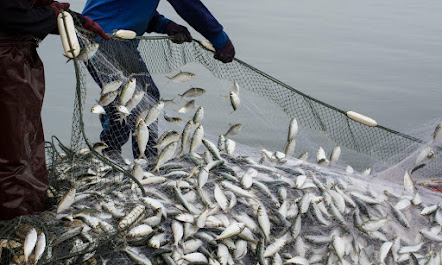
This is where the story gets quite interesting. Jesus, who is the son of a carpenter, and who we assume to be a carpenter himself, is telling Simon Peter, a well seasoned fishing boat captain, how to do his job. Jesus is like a city boy telling a farmer how to farm. Jesus is absolutely out of his element, he has no fishing credentials. Simon Peter told him that they had been out all night and hadn’t caught anything. But, Simon Peter conceded, and put the nets out one more time. And when they put their nets out, they caught so many fish that their nets were beginning to break. And then, Simon Peter, the fishing boat captain, the big fish if you will, drops down at Jesus’ knees, and confesses, right there in front of his whole crew, he acknowledges Jesus as Lord. And everyone was amazed.

And Jesus tells those fisherpeople not to be afraid, from now on they will be fishing for people, not fish. How stupid is that. Fishing for people sure won’t pay the bills. So what is this story about? It’s not about how to pay the bills. Simon Peter, James and John, and all the others left the catch of their lives, what they caught that morning probably would have kept them all in food, clothes, and new sandals for the foreseeable future.

Simon Peter recognized that day something amazing. He recognized Jesus. Simon Peter recognized Jesus and was willing to leave life as he knew it, life that was probably not cushy, but comfortable, for something that was completely unknown, for something that would scare him to death.

Jesus introduced to them that day a new way, a new economy if you will. So what does that have to do with us, we’re not fisher people.

You see, we live in an absurdly abundant world. A world where worldly success rests in our power to choose and our power to get. Our world is about an economy of getting, having, possessing. But Jesus’ economy costs us everything. After an absurdly abundant catch that Simon Peter, James and John and the others made that day, what on earth would make them pull their fishing boats up on the beach, leave them, and follow this prophet, this Jesus, the one who ate with sinners and women, the one who healed anyone, Jews and Greeks alike, the one who would be tortured and put to death. Wouldn’t they say, wouldn’t you say, do it again? Just do it again Jesus, we can all be rich. But instead, Simon Peter recognizes Jesus, and falls on his knees. And Jesus responds to Simon Peter and the rest with the call to bring in people, not fish. In the midst of the abundance, in the midst of this new wealth, they turn to follow Jesus and the new economy that he has for them.

What on earth would make anyone of us say yes to Jesus’ call of a new life, a new economy? In the midst of the absurdly abundant life many of us live, how do we recognize Jesus in our midst? People who recognize Jesus are not necessarily holy people, just ordinary people, we are ordinary fisher people and wives and mothers, fathers and children, youth and elders.

Recognizing Jesus in our midst is the call to be fishers of people. Recognizing Jesus is recognizing the truth that God loves us so much, God came into this world as one of us, so that we may love God and one another. God’s love is absurdly abundant. God’s love washes over us, as do the waters of baptism. God’s love nourishes us, as does the bread we break each time we meet together. God’s love is absurdly abundant, as the fish that were caught that day in the boat. How can we not be fishers of people, how can we not spread the Good News, when we know this truth.

But following Jesus is costly. Being fishers of people is to speak, and live, and behave in ways that Jesus in our midst is evident. It is to be with the other, as grace and gift and wonder.

It is to go to the grocery store and give thanks for the opportunity to choose, and it is to choose to fill the food bin at church each Sunday. It is to give thanks for the opportunity to be able to afford to buy food, and it is to advocate for those who cannot.

It is to go shopping and give thanks for the opportunity to choose, and to choose to dress modestly in fashion and in price, and it is to give a pair of shoes away for each pair of shoes we have sitting in our closets. It is to work for fair wages for those who make shoes.

It is to give thanks for the opportunity to learn each day, to go to school or work each day, and it is to approach those who are different than us with love and respect. It is to stand up for those who are teased or mistreated. We live in an absurdly abundant world. A world in which all that we have, and all that we are is bestowed upon us by an absurdly abundant God. Thanks be to God.

Saturday, January 19, 2019

2nd Sunday after the Epiphany Yr C Jan 20 2019


Audio  2nd Sunday after the Epiphany Yr C Jan 20 2019

When we listened to the first verses of John just a couple weeks back, we were reminded that the gospel writer very explicitly patterned the beginning of his story after the very beginning of the story in Genesis. The first verses of John are "In the beginning was the Word, and the Word was with God, and the Word was God. He was in the beginning with God. All things came into being through him, and without him not one thing came into being. What has come into being in him was life, and the life was the light of all people. The light shines in the darkness, and the darkness did not overcome it." And the first words of Genesis are "In the beginning when God created the heavens and the earth, the earth was a formless void and darkness covered the face of the deep, while a wind from God swept over the face of the waters. Then God said, ‘Let there be light’; and there was light. And God saw that the light was good."

The gospel writer is very intentionally setting the stage to say something about God, and the story we have before us today does just that. God, who is creator of all that is, seen and unseen, and who calls the creation good, God, who calls the Word into being, is the God of abundance, the God of grace.

Jesus, and his mother, and many of their relatives and friends, are at a wedding in the neighboring town of Cana. The wine ran out. This is problematic. Weddings were not really romantic affairs; they were much more an agreement between families to join forces. So the party they put on not only seals the deal, but also shows everyone what they’re made, and running out of wine threatens a serious loss of honor.

Jesus' mother was called into that shameful problem. We’ll never know why she was involved in the lack of wine, but it was probably the wedding of a relative or a close friend and she was helping out with the arrangements. We do know that, family and communities came to the aid of the host of wedding, or any other party or gathering there might be. Hospitality was an imperative, an essential priority. I don’t know that we can come close to understanding how important this is, it’s about offering a cold cup of water and a piece of bread, and it is about so much more.

Mary believes that Jesus can do something about that. Standing right there were six stone jars that held the water for washing feet, and other ceremonial washings, and for drinking water. Jesus had them filled to the brim. Now, a single family would have just one of these jars in their home. The relatives may have brought their family’s stone jar so there would be plenty of water for all these people. Each of those stone jars probably held between 20 and 30 gallons of water, for a total of about 150 gallons. That's enough water to fill a very large bathtub and the trough that will water your horses for a few days; it's a lot of water.

When the steward tasted the water that had become wine, he was astonished that the bridegroom and his family had saved the good wine until so late in the celebration. He is amazed at the hospitality that wine represents. This is the first sign in John’s gospel that show’s God’s abundance upon abundance. God’s grace upon grace.

John presents us with story after story that show forth God in our midst and God’s abundant love and grace. In each story we see and feel Jesus’ presence in creation, Jesus’ presence in the people who populate the story. Each story shows us God’s abundant presence and God’s abundant love. Jesus in the living water for the woman at the well, Jesus who heals the man who was ill for 38 years, and Jesus who heals the man blind from birth. And Jesus whose abundant love feeds five thousand, and last but not least, Jesus raises Lazarus from the dead. John shows God’s abundance, God’s glory, in each of these signs.

And this story, this story about this party shows us Jesus providing hospitality, turning an abundance of water into an abundance of wine, so that these families hosting this party, can continue their hospitality to others.  It’s not just about showing off, or some sort of magic trick, Jesus prevents these families from being shamed. The families of the bride and bridegroom retain their status, their honor. This is important because if they ran out, if they failed to show hospitality to all these guests, they would become outcast, they would be outsiders, they would be marginalized.

Now, I want to caution us from applying our own 21st century sensibilities to this story. My first reaction is well fine, no one needs that much wine anyway. And secondly, well, what’s the big deal about running out, no one’s going to judge them. But it was a big deal, hospitality was the biggest deal, and in this story, Jesus kept them from being cast out of the community. And this isn’t the only biblical story about how important hospitality is.

But the good news in this story is that as Jesus provides the best wine, in abundance. The good news is that God lavishes all of creation with abundant love and grace, that there are no outsiders in Jesus’ circle.

Too often we spend our time counting what we don’t have. Counting opportunities lost. We don’t have enough money or food or security or power or privilege. But that’s not what God’s love, and God’s grace looks like.

So today, I wonder if we can’t be more like Jesus. How might we surprise those around us with an abundance of blessing. What is it that you have a ton of and other people need? Is it smiles? What about hugs or hospitality? Who could we invite into our church, and our homes. Or what about space? How much more generous might we be? The possibilities, really, are endless. Another sign of God’s abundance, God’s grace, God’s love. God’s abundant love flows freely to all. There are no barriers, there are no walls, except those that we erect, that keep God’s love, and freedom, from any of God’s beloveds, including you.

Amen

Saturday, March 3, 2018

3 Lent Yr B March 4 2018


Love God, love others. Seems so simple, doesn’t it? That’s what these Ten Commandments from our Hebrew Bible are all about. As we heard them read this morning, the first four teach us about Loving God, and being loved by God. They tell us that God is God, and nothing else is, certainly not you or me. They tell us that this life is best lived with our full attention focused on God’s relationship with us. Because, as we well know, so much in this world would have us loosen our focus, divert our attention, from God to the things and stuff that we worship instead of God.

We’ve been talking about this during Lent already. We’ve considered this journey with Jesus and that it is about the relationship Jesus has with you, and with all of us. We’ve considered our intention for Lent, an intention that holds space for transformation, forgiveness, and repentance, an intention that invites our full attention on Jesus. What is it you must lay down, or let go of, so that you may take this journey with Jesus? Do you want to fast from something? Do you want to unattach yourself from something that holds your attention too strongly? That may be like an idol in your life?

The other six teach us about loving others. Honor your relatives, love and respect those around you. Don’t be overly attached to what you have, or what belongs to your neighbor. Take your vow taking and promise making seriously. And yet, it is so very hard for us.

John, in this fourth gospel shows us that Jesus is the embodiment of “grace upon grace”. Jesus is the embodiment of abundance. Jesus is the embodiment of these commandments. There is therefore no further need for sacrifice; Jesus’ incarnated, embodied grace suffices fully, wholly, entirely, and completely. Keep in mind; the Temple had become a marketplace out of necessity. In order to buy the animals for sacrifice, folks needed to change their Roman coins for Jewish ones and then purchase the proscribed animals. But with Jesus on the scene – the one who embodies abundance having just taken the waters of purification (also no longer needed) and turned them instead into the wine of celebration – there is no need for changing money, for purchasing animals, for making sacrifice…at all or ever again.

In John’s gospel, we see that Jesus’ body, incarnation, life, death, and resurrection, is enough. This is what Jesus’ words mean when he says, destroy the temple and in three days I will raise it up. Imagine what that meant to people whose experience of God was in the temple, in a very particular place. Whether or not we are aware of it, we are very comfortable talking about Jesus being in our hearts, Jesus being everywhere, encountering Jesus in nature, or one another. But the people who surrounded Jesus at the time this story takes place, had no idea like that. God was located in a very specific place, the temple. This was game changing. This was world ending and new world beginning. This is grace, abundance, and love.

You and I can be assured, because of Jesus’ life, death, and resurrection, that this amazing grace is available to us, anytime, anywhere. We do not have to work for it, and we do not have to be perfect, because we are perfectly loved. This little passage holds so much meaning for our lives today. You see, when you are broken, you will be healed. When you are at the end of your patience, you will receive peace. In any time and any place you find yourself, God’s grace, and love, and hope, will encourage, comfort, and restore. 

Jesus is God’s presence with us, what does that look and feel like? If we take this seriously, we must be changed, transformed. If Jesus is God’s presence with us, Jesus is also God’s presence with all people, there are no better than or worse than people. There are no people who have God and people who do not have God. Jesus resides in and through and among all of us, this is incarnation, God with us. So I think what this story about Jesus in the temple shows us is that Jesus cannot be commodified or consumerized. Jesus cannot be bought and sold for personal gain or personal agendas. Using the label Christian is not like going to the store, buying a piece of jewelry with a cross on it and calling yourself Christian.

Following Jesus, this Jesus who would have nothing to do with transactions in the temple, is about being transformed by abundant grace, it is about coming to this table and being made whole in God’s image. It is about water and wine that heal the holes in our hearts that are created by moment upon moment of being ripped and torn apart by the harsh words and realities of the world in which we live.

Following Jesus, who turned the tables in the temple, is about being fed with the bread that fills our bellies with food that nurtures, sustains, and sends us out into the world to do the work of justice that God gives us to do.

Following Jesus, who manages the moneychangers, is about using our money and our resources for the good of creation and for the good of our community. The stewardship of our resources is a moral statement of how we understand God’s incarnation, and how we are invested in God’s kingdom.

Following Jesus, who is God in our midst, Jesus who is grace upon grace, is about a changing heart; it is the most costly exchange of all. You see, in following Jesus, we are consumed by love, and by grace, and we let go of the stuff that keeps our hearts hardened, that holds us hostage.

And we are sent out to do the work that God will have us do. The work that bears God’s grace and abundance into all the places we find ourselves. This is the work of justice. Justice that creates a world in which our children and teachers are safe. Justice that creates a world in which all people are fed. Justice that protects our water, our earth.

Jesus is not interested in transaction, Jesus is interested in transformation. Jesus is not interested in buying and selling religion or morality, Jesus is interested in loving God, loving others, and showing it. Amen.

Nineteenth Sunday after Pentecost, Proper 22 Yr A October 4 2026, Sts. Martha and Mary, Eagan

Nineteenth Sunday after Pentecost, Proper 22 Yr A October 4 2026, Sts. Martha and Mary, Eagan Exodus 20:1-4, 7-9, 12-20, Psalm 19, Philippia...